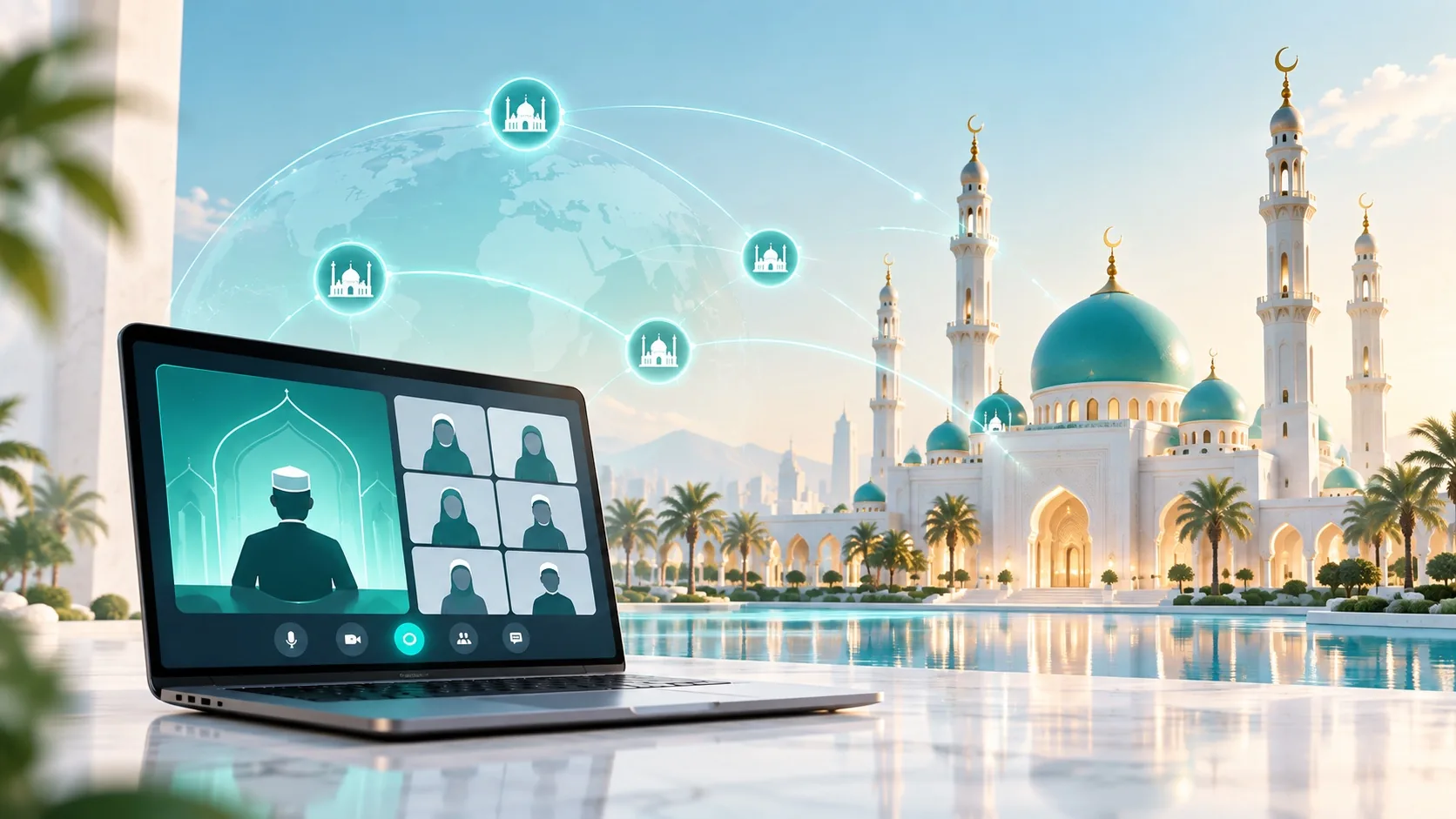
A few years ago, if you wanted your child to learn Qur'an, you found the local maktab, dropped them off after school and picked them up two hours later. That still happens, alhamdulillah, and it always will. But something else has been quietly growing alongside it.
Today there are ustadhs teaching tajweed to students in three different countries from their front room. Alimah courses running entirely over video calls. Hifz circles where the teacher is in Leicester and the students are in Dubai, Toronto and Lagos. Weekend Arabic classes for reverts who don't have a masjid nearby. Sisters' halaqahs that meet online because that's the only time everyone can make it once the kids are asleep.
Online Islamic education isn't a side thing anymore. For a lot of families it's the main thing.
The classes moved online. Nothing else did.
Here's the problem we kept running into when we spoke to teachers running online classes. They had a Zoom link. And that was it.
The link gets pasted into a WhatsApp group. Half the parents miss it because the group has 400 unread messages. Someone asks "is class on today?" every single week. Attendance is either not taken at all or it's a teacher squinting at a grid of tiny video tiles trying to remember who turned up. Recordings get dumped into a shared Google Drive folder, and suddenly every student can see every file in there, including stuff that was never meant for them.
There's no portal. No register. No way for a parent to see if their son actually logged in on Tuesday. No way for the madrasah to know which students are slipping. Everything that a physical maktab does naturally, just by having kids walk through a door, disappears the moment the class goes online.
We looked around for something built for this. Proper software for online maktabs and madrasahs, made by people who understand how Islamic classes actually run. There wasn't anything. Generic school software doesn't get it. Generic video tools don't track anything. The existing maktab platforms were all built for a building with a front door, and online was an afterthought at best.
So as far as we know, Labbaik is the first platform genuinely built to serve online madrasahs and Islamic classes. Not a bolt-on. Not a workaround. The actual thing.
How it works
We wanted this to be simple enough that a teacher who isn't "techy" could set it up in an afternoon. Here is what it looks like.
Connect your Zoom. You link your organisation's own Zoom account to Labbaik. When you set up a class, the meeting link is attached to it automatically. No more copying and pasting links into group chats every week.
Students get alerted when class starts. When it's time for class, students and parents get a notification. Nobody has to ask whether it's on. Nobody has to dig through a chat to find the link.
They join through the student portal, and attendance marks itself. This is the bit teachers love most. Students join the class from their Labbaik student portal, and when they do, they're marked present. The teacher doesn't have to take a register. The madrasah gets a real attendance record for online classes, the same way it would for in person ones, and parents can see it too.
Recordings from your own Google Drive or Dropbox. Connect whichever one you already use, and upload your class recordings as normal. The important part: Labbaik only shows students the recordings your organisation has chosen to publish. Not your whole drive. Not the folder with the committee minutes and last year's accounts. Just the lessons you've picked, in the student portal, ready to watch back. Your files stay in your own storage, where they belong.
You can read more about the setup on our online classes page.
Free. Actually free.
All of this is on our Safar plan, and Safar has no monthly cost. No setup fee. No student cap. No card needed to sign up.
The only time Labbaik makes any money from you is if you choose to collect fees or donations by card through Stripe. Then there's a small platform fee on those payments. If you collect fees in cash or by bank transfer, or don't charge at all, you pay us nothing. That's it. You can see the full breakdown on our pricing page.
We did it this way on purpose. A lot of online classes are run by one ustadh or a small group of volunteers, often charging very little or nothing at all. The last thing they need is another monthly bill for software. If you're not earning through the platform, we shouldn't be either.
Bigger than online classes
Online classes are one part of what we're building, but they come from the same place as everything else in Labbaik.
The goal has always been to bring the ummah onto one platform. Right now the average Muslim family deals with a different system for everything. One app for the maktab. A WhatsApp group for the masjid. A separate website to donate. A Google Form for the Eid event. A spreadsheet somewhere tracking Hifz progress. None of it talks to each other and none of it was built for us.
Labbaik puts it all in one place. Masajid, maktabs, madrasahs, online classes and charities, with attendance, Hifz and Qur'an tracking, fees, donations, events, certificates and WhatsApp updates sitting side by side. A student who learns online with a teacher abroad and also goes to their local masjid on weekends can have both in the same account. A parent can see everything their children are doing without juggling five logins.
And because it works across countries, currencies and languages, it doesn't matter where the teacher is or where the students are. That's the whole point. The ummah was never meant to be split up by postcode, and online learning proves it every day. We just want the tools to catch up.
If you teach online, this is for you
Whether you run a full online madrasah with hundreds of students, a small Qur'an class on Zoom, or a weekly halaqah for new Muslims, you shouldn't have to hold it all together with WhatsApp groups and hope.
Give your students a proper home. Let the register take itself. Share your recordings without opening up your whole drive. And do it without paying a monthly fee.
Sign up to Labbaik today, connect your Zoom, and run your next class the way it should have been run from the start. We'd love to have you with us.