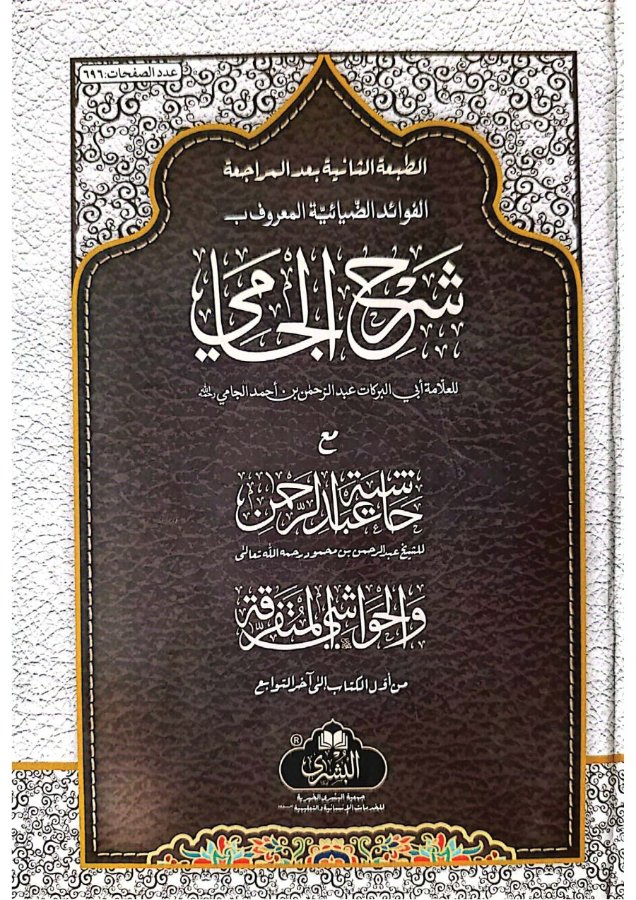
Nahw · Alimiyyah
Sharh al-Jami (al-Fawa'id al-Diya'iyyah)
شرح الجامي
Sharh al-Jami (al-Fawa'id al-Diya'iyyah) is a Nahw kitab on the Alimiyyah shelf of the Labbaik Library, split into the 71 sections teachers track it by. Add it to a class in one tap and see where every class and student is in it, section by section.
- Publisher
- Maktabat al-Bushra (Al-Bushra Welfare and Educational Trust), Karachi, 2nd revised edition, 1446 AH / 2025
- Sections
- 71
- Pages
- 619
- Volumes
- 2
Contents of Sharh al-Jami (al-Fawa'id al-Diya'iyyah)
The 71 sections teachers mark progress against, in order, with their English names and the printed page numbers.
- Volume 1
- 1مقدمة الناشرPublisher's Introductionpp. 3–5
- 2منهج عملناOur Editorial Methodpp. 6–7
- 3ابن الحاجب والجاميBiographies of Ibn al-Hajib and al-Jamip. 8
- 4مقدمة الكتابIntroduction of the Book (Muqaddimat al-Kitab)pp. 9–21
- 5مبحث الكلمةMabhath al-Kalimah (Discussion of the Word)pp. 22–25
- 6تحقيق اللفظInvestigation of al-Lafz (the utterance)pp. 26–30
- 7تحقيق الوضعInvestigation of al-Wad' (linguistic assignment)pp. 31–34
- 8تحقيق المعنىInvestigation of al-Ma'na (the meaning)pp. 35–40
- 9تحقيق المفردInvestigation of al-Mufrad (the single word)pp. 41–50
- 10مبحث الكلمة: أقسام الكلمةDiscussion of the Word: Divisions of the Wordpp. 51–52
- 11مبحث الكلمة: دليل الحصرDiscussion of the Word: The Proof of the Restriction to Threepp. 53–56
- 12مبحث الكلمة: إيضاح حد كل واحد منهاDiscussion of the Word: Clarifying the Definition of Each Onepp. 57–58
- 13مبحث الكلام: حد الكلامDiscussion of Speech: Definition of Kalampp. 59–60
- 14مبحث الكلام: حد الإسنادDiscussion of Speech: Definition of Isnadp. 61
- 15مبحث الكلام: فوائد القيودDiscussion of Speech: Benefits of the Qualifiers in the Definitionpp. 62–64
- 16مبحث الكلام: المتعلقات خارجة عن الكلام أو داخلة فيهDiscussion of Speech: Whether Adjuncts Are Outside or Inside Kalamp. 65
- 17مبحث الكلام: بيان النسبة بين الكلام والجملةDiscussion of Speech: Relation Between Kalam and Jumlahp. 66
- 18مبحث الكلام: أجزاء الكلامDiscussion of Speech: Parts of Kalampp. 67–68
- 19مبحث الاسم: حد الاسمDiscussion of the Noun: Definition of the Ismpp. 69–85
- 20التوطئة لبيان خواص الاسمIntroduction to the Distinguishing Features of the Nounp. 86
- 21خواص الاسمKhawass al-Ism: Distinguishing Features of the Nounpp. 87–97
- 22مبحث المعرب: تقسيم الاسمDiscussion of the Mu'rab: Division of the Nounp. 98
- 23مبحث المعرب: تحقيق المعربDiscussion of the Mu'rab: Verification of the Mu'rabpp. 99–107
- 24مبحث المعرب — حكم المعربMabhath al-Mu'rab: The ruling of the Mu'rabpp. 108–113
- 25مبحث المعرب — تحقيق الإعرابMabhath al-Mu'rab: Investigating I'rabpp. 114–120
- 26مبحث المعرب — أنواع الإعرابMabhath al-Mu'rab: Types of I'rabpp. 121–123
- 27مبحث المعرب — تحقيق العاملMabhath al-Mu'rab: Investigating the 'Amilpp. 124–138
- 28مواضع الإعراب اللفظي والتقديريPlaces of Lafzi and Taqdiri I'rabpp. 139–146
- 29التوطئة لحد غير المنصرفIntroduction to the definition of Ghayr al-Munsarifp. 147
- 30مبحث غير المنصرفDiscussion of Ghayr al-Munsarif (the diptote)p. 148
- 31بيان العلل التسعThe nine causes (al-'Ilal at-Tis')pp. 149–152
- 32مبحث غير المنصرف — تحقيق حكم غير المنصرفGhayr al-Munsarif: Verifying the ruling of the diptotep. 153
- 33مبحث غير المنصرف — تحقيق مشابهة غير المنصرف بالفعلGhayr al-Munsarif: Verifying the diptote's resemblance to the verbpp. 154–155
- 34مبحث غير المنصرف — صرف غير المنصرف للضرورة أو غيرهاGhayr al-Munsarif: Making a diptote take tanwin for necessity or otherwisepp. 156–159
- 35مبحث غير المنصرف — ما يقوم مقام العلتينGhayr al-Munsarif: What stands in place of two causespp. 160–161
- 36مبحث غير المنصرف — تحقيق العدلGhayr al-Munsarif: Verifying 'adl (deviation)pp. 162–178
- 37مبحث غير المنصرف — تحقيق الوصفGhayr al-Munsarif — Tahqiq al-Wasf (Adjective as a cause)pp. 179–185
- 38مبحث غير المنصرف — تحقيق التأنيثGhayr al-Munsarif — Tahqiq at-Ta'nith (Feminine as a cause)pp. 186–191
- 39مبحث غير المنصرف — تحقيق المعرفةGhayr al-Munsarif — Tahqiq al-Ma'rifah (Definiteness as a cause)pp. 192–194
- 40مبحث غير المنصرف — تحقيق العجمةGhayr al-Munsarif — Tahqiq al-'Ajamah (Foreign origin as a cause)pp. 195–199
- 41مبحث غير المنصرف — الجمعGhayr Munsarif: Al-Jam' (plural as a cause)pp. 200–215
- 42مبحث غير المنصرف — التركيبGhayr Munsarif: At-Tarkib (compounding as a cause)pp. 216–219
- 43مبحث غير المنصرف — الألف والنونGhayr Munsarif: Al-Alif wan-Nun (the added alif and nun)pp. 220–230
- 44مبحث غير المنصرف: جعل غير المنصرف منصرفاMabhath Ghayr al-Munsarif: Making a diptote munsarifpp. 231–236
- 45مبحث غير المنصرف: مخالفة سيبويه الأخفشMabhath Ghayr al-Munsarif: Al-Akhfash's disagreement with Sibawayhpp. 237–241
- 46مبحث غير المنصرف: إلزام الأخفش سيبويه بباب حاتمMabhath Ghayr al-Munsarif: Al-Akhfash's argument against Sibawayh from Bab Hatimpp. 242–243
- 47مبحث غير المنصرف: انجرار غير المنصرف بالكسرMabhath Ghayr al-Munsarif: The diptote taking kasra in the genitivepp. 244–246
- Volume 2
- 48المرفوعات – ١- الفاعلMarfu'at – 1: The Fa'il (subject)pp. 5–59
- 49٢- مفعول ما لم يسم فاعله2: Maf'ul ma lam yusamma fa'iluh (passive subject)pp. 60–71
- 50٣- المبتدأ ٤- والخبر3–4: Mubtada and Khabarpp. 72–130
- 51٥- خبر إن وأخواتها5: Khabar of Inna and its sisterspp. 131–137
- 52٦- خبر لا التي لنفي الجنس6: Khabar of La li-nafy al-jinspp. 138–143
- 53٧- اسم ما ولا المشبهتين بليس7: Ism of Ma and La resembling Laysapp. 144–148
- 54المنصوبات – ١- المفعول المطلقMansubat – 1: Maf'ul Mutlaqpp. 149–177
- 55٢- المفعول به2: Maf'ul bihpp. 178–294
- 56٣- المفعول فيه3: Maf'ul fihpp. 295–306
- 57٤- المفعول له4: Maf'ul lahpp. 307–318
- 58٥- المفعول معه5: Maf'ul ma'ahpp. 319–323
- 59٦- الحال6: Halpp. 324–359
- 60٧- التمييز7: Tamyizpp. 360–398
- 61٨- المستثنى8: Mustathnapp. 399–442
- 62٩- خبر كان وأخواتها9: Khabar of Kana and its sisterspp. 443–449
- 63١١- اسم إن وأخواتها ١٢- اسم لا التي لنفي الجنس11–12: Ism of Inna and its sisters; Ism of La li-nafy al-jinspp. 450–472
- 64١٣- خبر ما ولا المشبهتين بليس13: Khabar of Ma and La resembling Laysapp. 473–476
- 65المجروراتMajrurat (genitive nouns)pp. 477–535
- 66التوابع – تحقيق التوابعTawabi' – Introduction to the followerspp. 536–541
- 67١- النعت1: Na't (adjective)pp. 542–562
- 68٢- العطف2: 'Atf (conjunction)pp. 563–585
- 69٣- التأكيد3: Ta'kid (emphasis)pp. 586–599
- 70٤- البدل4: Badal (substitute)pp. 600–613
- 71٥- عطف البيان5: 'Atf al-bayanpp. 614–619
Only the cover and this outline are shared, never the kitab’s contents. All credit belongs to its author and publisher.
Tracking Sharh al-Jami (al-Fawa'id al-Diya'iyyah) in Labbaik
- Add it to a class. Pick it from the Library in one tap. Its sections come with it, so nobody types out a contents page.
- Mark progress as you teach. The ustadh marks each section as the class reaches it, and can mark any student who is ahead or behind.
- See where everyone is. The principal sees every year group's place in every kitab, and adult students see their own progress in the portal.
More on running an Alimiyyah programme: Labbaik for Darul Ulooms and Islamic institutes, the Dars-e-Nizami syllabus year by year, and the guide to Darul Uloom software.
More Nahw kitabs in the Library
- Al-Kafiyah (Ibn al-Hajib) · كافية
- Al-Minhaj fi al-Qawa'id wa al-I'rab · المنهاج في القواعد والإعراب
- Al-Nahw al-Wadih fi Qawa'id al-Lughah al-'Arabiyyah (Secondary, Parts 1–3) · النحو الواضح في قواعد اللغة العربية للمدارس الثانوية (الأجزاء ١-٣)
- Bughyat al-Kamil as-Sami (Sharh al-Mahsul wal-Hasil lil-Jami) · بغية الكامل السامي شرح المحصول والحاصل للجامي
- Hidayat un-Nahw · هداية النحو
- Ilm un-Nahw · علم النحو
- Iqna' ad-Damir (Arabic translation of Nahw Mir) · إقناع الضمير ترجمة نحو مير
- Maarif al-Kafiyah wa Awarif al-Jami · معارف الكافية وعوارف الجامي
- Nahw Mir · نحو میر
- Sharh Mi'at Amil · شرح مائة عامل
- Tashil an-Nahw (Nahw Mir with teaching method) · تسہیل النحو یعنی نحو میر مع طریقۂ تعلیم